


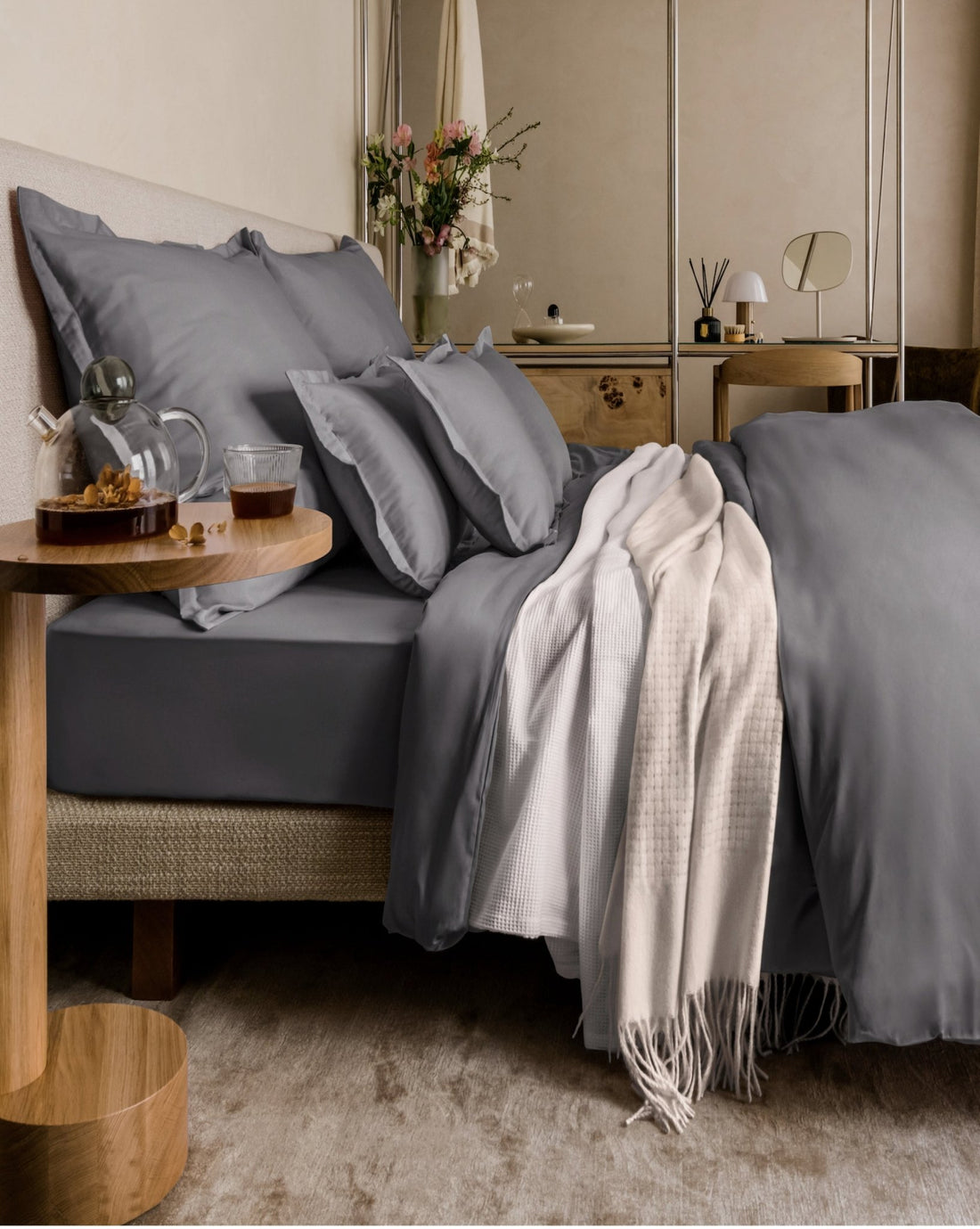


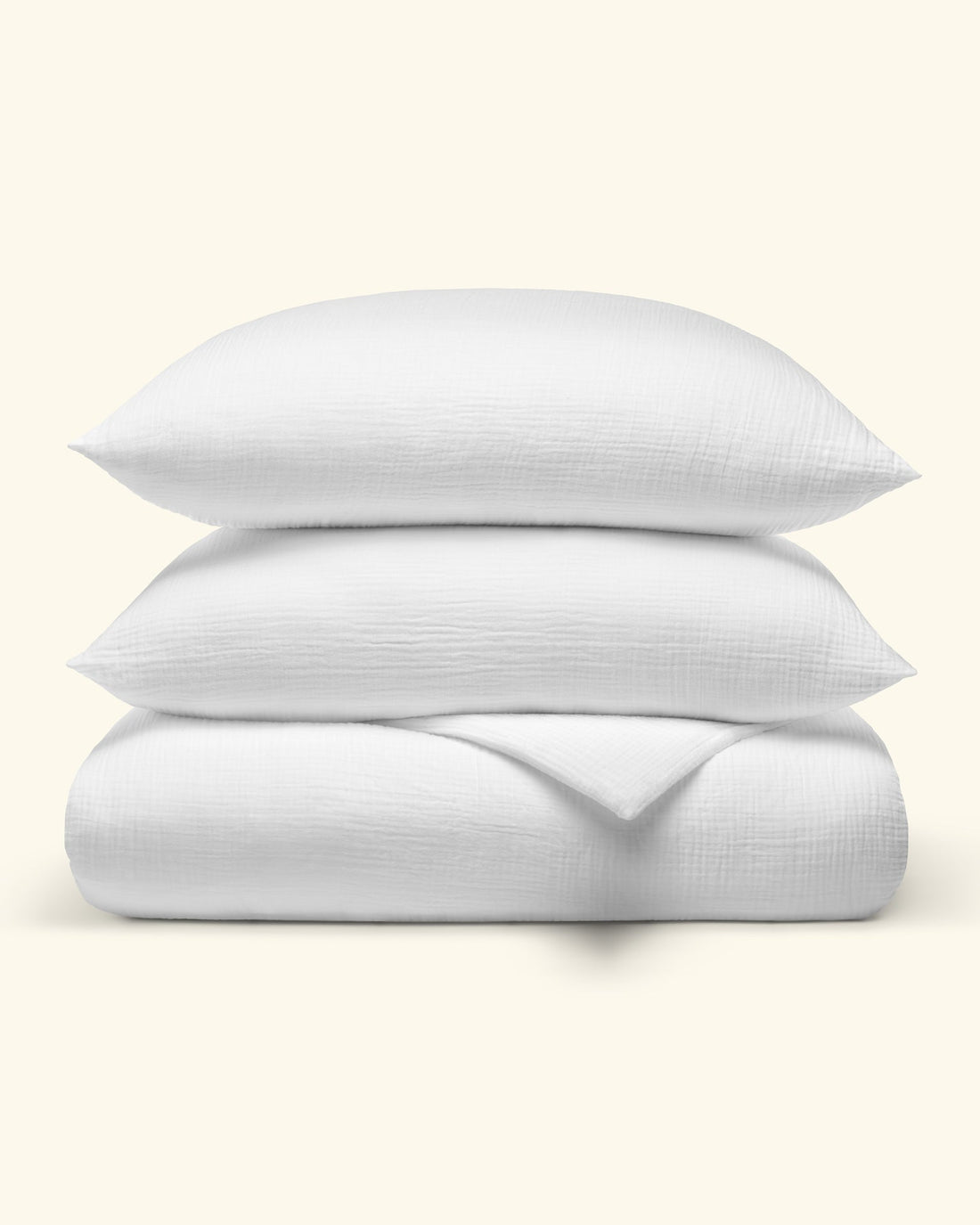


When it gets cold outside, many people reach for Biber bedding. It feels warm the moment you get into bed. This lesson explains why, how Biber differs from flannel and fine Biber, and what to look out for.
What is Biber?
Biber is a densely woven cotton fabric. After weaving, it is roughened on one or both sides.1 Brushes pull small fibre ends out of the yarn. They stand up and form a soft, fluffy nap.
The fabric is named after the beaver („Biber“ in German). The animal has very dense fur that keeps it warm in cold water.1 For bedding, Biber is usually woven in a plain weave today – just like percale. The brushing is what makes the difference.1
From smooth fabric to Biber
Brushes pull fine fibre ends out of the fabric.

In short: Biber is ordinary cotton that is roughened after weaving. The brushing makes it fluffy.
Why does Biber keep you warm?
The raised fibre ends form a thin layer on the fabric. Air stays still between them.3 Still air lets warmth through only slowly, so your body heat stays in the bed longer.
There is also the feel on your skin: a smooth fabric touches your skin with its whole surface, so it feels cool at first. With Biber, you mainly touch the soft fibre ends. That is why it feels warm straight away.1
Smooth or brushed
In Biber, the nap holds a layer of air.

In short: the nap holds air, and air keeps you warm. That is why Biber feels warm straight away.
Biber, flannel, fine Biber: the difference
The three names are often mixed up. It is simple:
| What is it? | Made of | |
|---|---|---|
| Flannel | umbrella term for roughened fabrics with a soft, fluffy surface | wool or cotton |
| Biber | flannel made of cotton, densely woven and roughened | cotton |
| Fine Biber | Biber made from lighter, thinner yarns, so less stiff | cotton |
One family, three names
Biber is flannel made of cotton.

How warm and opaque Biber is depends mainly on its weight, given in grams per square metre (g/m²). Fine Biber is the lightest, usually between 100 and 140 g/m². It is soft, but thinner. Ordinary Biber usually weighs 150 to 160 g/m². Our Biber bedding weighs 200 g/m² and also has the velvet finish: dense, opaque and with a full, soft hand feel.
Light or dense
The weight per square metre makes the difference.

Watch out for blends: some brands mix polyester into their Biber because it is cheaper.3 The weight can even be a little higher. That does not make the Biber better: polyester tends to bobble, while cotton breathes and absorbs moisture well.3 So check the label: good Biber is 100 % cotton.
In short: flannel is the umbrella term. Biber is flannel made of cotton, fine Biber a lighter, thinner Biber. Ordinary Biber usually weighs 150 to 160 g/m², our velvet Biber 200 g/m². Look for 100 % cotton rather than a polyester blend.
The honest downsides of Biber
- Lint at first: loose fibre ends come off in the first washes. That is normal for brushed cotton and stops after a while. With a velvet finish, long, loose fibre ends are sheared off,5 so velvet flannel sheds less lint.
- Bobbles where it rubs: ordinary flannel can form small bobbles where there is a lot of friction, for example at the foot end.3 Light fine Biber is more prone to it. The velvet finish prevents it: the short, dense nap hardly bobbles.
- Not for summer: Biber is made for autumn and winter. From spring on, most people find it too warm.
In short: ordinary flannel sheds lint at first and can bobble where it rubs. Velvet flannel sheds less and hardly bobbles. In summer, any Biber is too warm.
Care: washing and drying
| Step | How |
|---|---|
| First wash | wash separately |
| Washing | up to 60 °C; close the zip |
| Detergent | no fabric softener |
| Drying | tumble-dryer safe |
In short: wash separately the first time, up to 60 °C, no fabric softener – and the nap stays soft for a long time.
What this means for your bed
- You get cold easily at night, or your bedroom is cool: Biber.
- You want it soft but not quite as thick: fine Biber.
- You get warm quickly at night: percale, even in winter.
- You want one bedding for the whole year: Mako sateen.
What is a velvet finish?
Most Biber bedding is ordinary flannel: the fabric is brushed, and that is it. Many long, loose fibre ends are left standing. They are exactly what turns into small bobbles later.4
A velvet finish takes the finishing further. On a special machine, the brushed nap is sheared to an even height and then finely sanded.5 This creates a short, dense nap that feels like velvet – hence the name. Long, loose fibre ends hardly remain, so velvet flannel hardly forms bobbles.
Ordinary Biber or velvet finish
An evenly short nap instead of long, loose fibre ends.

In short: a velvet finish makes the nap short, dense and even. The fabric feels like velvet and hardly bobbles – a class above ordinary Biber.
Biber from AMQUA
Our Biber bedding is 100 % long-staple cotton, brushed on both sides. Long fibres make a smooth, soft yarn – that is why our nap is especially soft.
Our Biber is velvet flannel: after brushing, it gets the velvet finish on a special machine. It feels like velvet and hardly bobbles – unlike ordinary flannel. At 200 g/m², it is dense, opaque and has a full, soft hand feel.
Our Biber is certified to OEKO-TEX® STANDARD 100. It is woven and finished by a family mill in Portugal, in its third generation.
- concealed zip on duvet cover and pillowcase
- ties inside the four corners so the duvet stays in place
- fitted sheets for mattresses up to 30 cm deep
- plastic-free packaging
Available in cream white and beige. Free shipping to Germany and Austria, 100-day trial from the date of purchase.
Sources
- Wikipedia. Biber (Stoff) (German). de.wikipedia.org (retrieved 8 November 2026).
- Wikipedia. Flanell (German). de.wikipedia.org (retrieved 8 November 2026).
- Fashionary. Textilepedia – The Complete Fabric Guide. Hong Kong 2021, pp. 012, 018–019, 055, 100.
- Wikipedia. Nap (fabric). en.wikipedia.org (retrieved 8 November 2026).
- Cotton Incorporated. Napping of Cotton Fabrics (TRI 3006). cottoninc.com (retrieved 8 November 2026).