





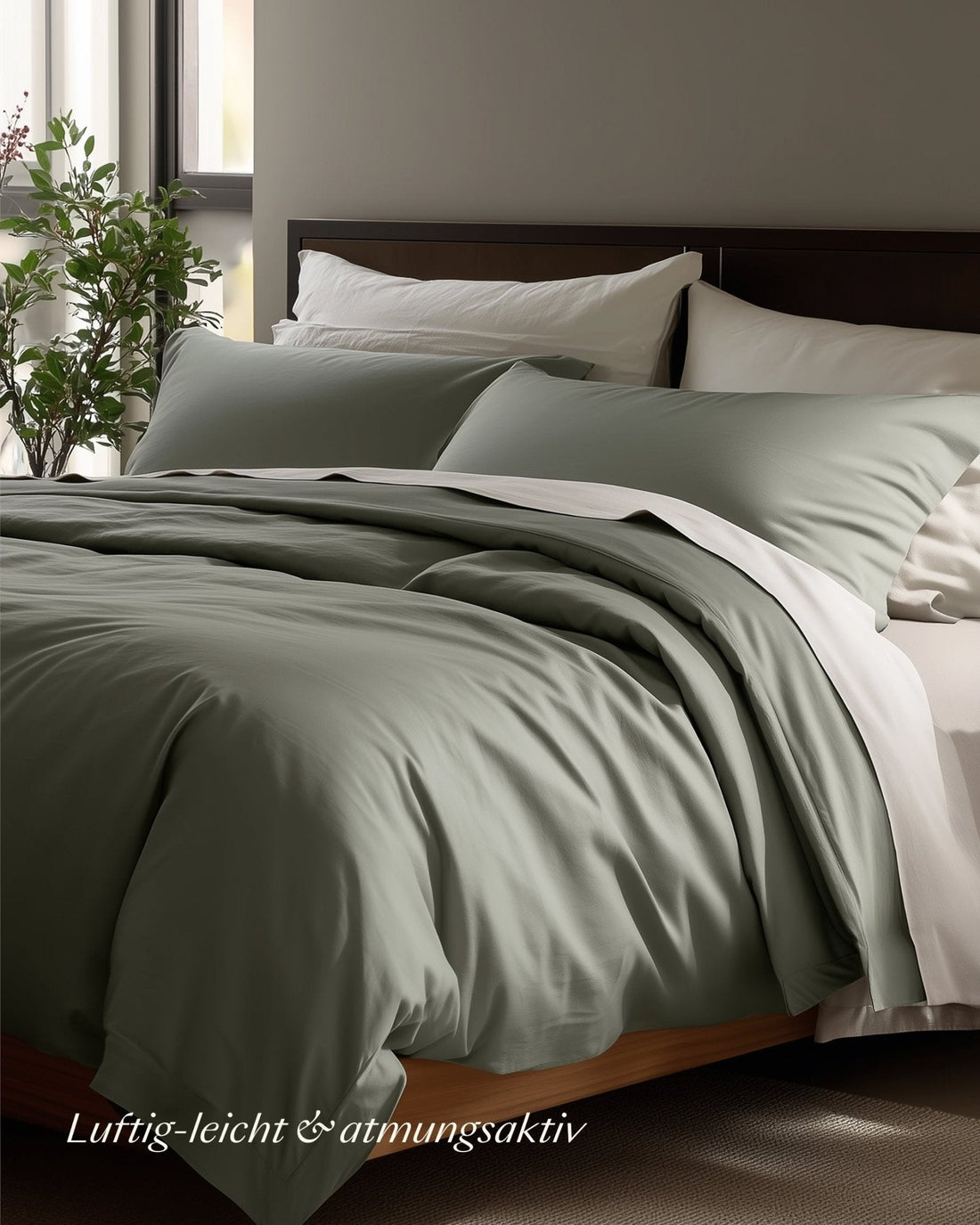
Percale or sateen? Many people face this question when buying bedding. Both are cotton, yet they feel completely different. This lesson explains where the difference comes from and which fabric suits you.
The difference is the weave
Every fabric is made of lengthwise and crosswise threads. In percale, each thread goes over one and under one other thread, in turn. This is called a plain weave.3 It creates a great many crossing points. They hold the fabric firmly together and make it matt.1
In sateen, one thread passes over four others before it goes under one. That leaves long stretches of thread lying side by side on top. They reflect the light: the fabric has a soft sheen and feels smooth.2
Two weaves
Many crossing points or long stretches of thread.

In short: the same cotton, a different weave – that makes all the difference.
How do they feel?
| Percale | Sateen | |
|---|---|---|
| Surface | matt | smooth, soft sheen |
| Hand feel | crisp, like a freshly ironed shirt | soft and supple |
| Drape | a little firmer, lies loosely | falls softly and hugs the body |
| Back | looks like the front | matt |
Sateen is soft from the start. Ordinary percale, on the other hand, has to be broken in – like a new pair of jeans. They are stiff at first and only get comfortable once you have worn them for a while and washed them a few times. In the same way, new percale often feels hard and a little rough for the first few nights. It gets softer with every night and every wash.
That is why some people actually like percale but find it too hard to sleep in at first.
In short: percale is crisp and matt, sateen smooth and soft. Ordinary percale needs a few weeks to get soft.
Soft from day one: percale with a peach finish
With our percale, you do not have to wait. After weaving, it gets a peach finish: the surface is sanded very finely by machine, without chemicals.1 Afterwards it feels soft, a little like the skin of a peach – hence the name.
So our percale feels like well broken-in percale from the very first night. It stays matt and feels cool, but it is no longer hard.
In short: ordinary percale takes time to get soft. Our percale with a peach finish is soft from day one.
Which is cooler?
Percale feels cooler and drier. Sateen lies more smoothly on the skin and holds a little more warmth under the duvet. Both are cotton: they let air through and absorb moisture.1
If you get warm quickly at night, you will usually sleep more comfortably in percale. If you get cold easily, you will often prefer sateen. For very cold nights, Biber is warmer than both.
In short: if you get warm, choose percale. If you get cold, choose sateen.
Which lasts longer?
The many crossing points make percale a firm fabric.1 It copes well with frequent washing.
Sateen is softer, but more delicate. Because the threads lie on top for a long stretch, a single thread can snag more easily and be pulled out, for example by a cat's claws.1
In short: percale is sturdier. Sateen is softer, but needs a little more care.
220 or 300 threads: why both are good
Thread count tells you how many threads lie in one square inch, about 2.5 × 2.5 cm.1 Many shops advertise high numbers. But the number alone says little: what matters is how fibre, yarn and weave fit together.1
A satin weave has room for more threads than a plain weave.2 Our percale has 220 threads, our sateens have 300. That is not a difference in quality. It comes from the weave. You can read more about very high thread counts in the lesson What is Egyptian cotton?
In short: compare thread counts only within one weave, never between percale and sateen.
Care and ironing
| Percale | Sateen | |
|---|---|---|
| Washing | up to 60 °C | 40 °C recommended; up to 60 °C when heavily soiled |
| Drying | tumble-dryer safe; gentle and low is kinder | tumble dry low, take out straight away |
| Creasing | creases, because it has no chemical easy-iron finish | creases a little |
| Ironing | iron slightly damp for a smooth hotel look | iron for a silky smooth feel; unironed it looks casually crinkled |
In short: if you like it smooth, iron both. Ironed sateen feels especially silky.
And renforcé?
Renforcé is also woven in a plain weave, just like percale. But its yarn is only medium-fine.4 It is usually coarser and made from simpler cotton, and renforcé usually has only about 110 to 140 threads. Percale, on the other hand, is particularly fine and densely woven.3 Renforcé is sturdy, but feels less fine.
In short: renforcé is percale's simpler sibling: the same weave, coarser yarn, fewer threads.
What this means for your bed
- You get warm quickly at night: percale.
- You get cold easily or like it smooth and soft: sateen.
- Pets sleep in your bed: percale.
- You like percale but not hard first nights: our percale with a peach finish.
- You never want to iron: muslin.
- You do not like a sheen: percale.
- You want one bedding for the whole year: Mako sateen.
Which fabric suits you?
The decision at a glance.

Percale and sateen at AMQUA
Our percale is from SERALINO: made of long-staple cotton (Better Cotton), with 220 threads and certified to OEKO-TEX® STANDARD 100. Thanks to its peach finish it is soft from day one. It is made in India. It comes as duvet cover sets and as pillowcases.
We offer sateen in two versions, both with 300 threads: Mako sateen from Egyptian cotton (AMQUA, Giza 92, woven in Portugal) and Mako sateen from organic cotton (SERALINO, GOTS).
Free shipping to Germany and Austria, 100-day trial from the date of purchase.
Shop Mako sateen from Egyptian cotton →
Shop Mako sateen from organic cotton →
Sources
- Fashionary. Textilepedia – The Complete Fabric Guide. Hong Kong 2021, pp. 010, 018–019, 076, 108, 214.
- Wikipedia. Atlasbindung (German). de.wikipedia.org (retrieved 8 November 2026).
- Wikipedia. Perkal (German). de.wikipedia.org (retrieved 8 November 2026).
- Wikipedia. Renforcé (German). de.wikipedia.org (retrieved 8 November 2026).